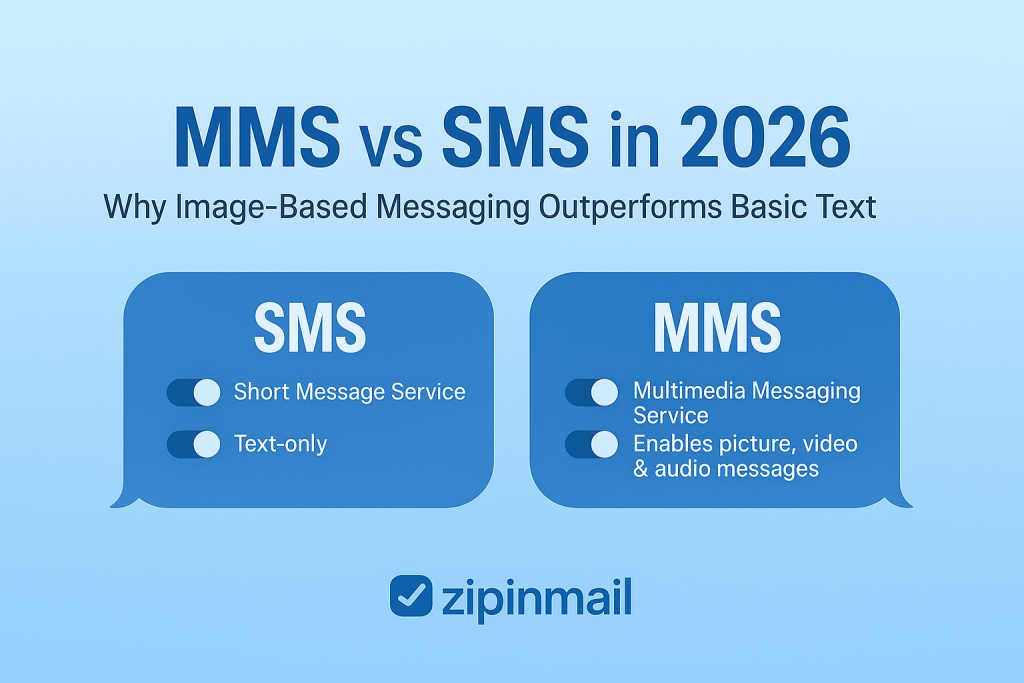
Why MMS Is Outperforming Regular Text Marketing in 2026
In 2026, every marketer is running into the same problem: customers aren’t reacting to plain text messages the way they used to. Not because texting has stopped working, but because basic SMS has become background noise.
People see a block of text and make a split-second decision:
skim it, delete it, or save it for later (which usually means never).
So the industry has quietly started to shift. MMS — the richer, visual version of texting — is becoming the format people actually respond to. Not because it’s new, but because it matches the way consumers already behave everywhere else:
scrolling visual content, processing images instantly, and reacting to what stands out first.
This is where the real difference between regular SMS and MMS begins.
How Consumers Treat Regular SMS in 2026
Text messaging used to feel personal. That’s why businesses rushed into SMS ten years ago — they thought the channel itself would guarantee engagement. But as more companies added SMS into their marketing mix, the feeling shifted.
Today, the average consumer expects a regular text message to be:
• short
• transactional
• easily ignored
If it looks like every other text alert — meaning, a sentence and a link — we already know what happens. The customer glances at it the same way they glance at email subject lines: quickly, half-attentively, and with very little memory of what they saw.
SMS still delivers reach, yes.
But reach is no longer the problem.
Retention is. Attention is. Recall is.
SMS doesn’t create any of those.
Most SMS marketing today earns a reaction only if the person is already motivated or already looking for the offer. It doesn’t persuade — it just informs.
MMS Interrupts the Brain Differently — and That’s Why It Works
MMS doesn’t behave like SMS at all.
It hits the inbox with a visual. A cue. A micro-experience.
That matters because the human brain processes images dramatically faster than text. It decides “this is interesting,” “this is irrelevant,” or “this is useful” before the customer consciously thinks about it.
In other words: MMS forces attention, SMS asks for it.
And in 2026, attention is the only currency that still matters.
A sentence can be ignored.
An image triggers interpretation.
That tiny difference is why MMS consistently outperforms SMS in:
• open behavior
• recall
• conversions
• shareability
• time spent reading
If SMS is a knock on the door, MMS is someone standing right in front of you holding up what they need you to see.
The Engagement Gap Between SMS and MMS Is Getting Wider
Here’s the part marketers didn’t expect:
as digital feeds get more visual — TikTok, IG Stories, YouTube Shorts — people now expect visual cues everywhere. Plain text feels incomplete. It feels like something is missing.
Businesses sending SMS-only messages are noticing the drop-off:
People open them but don’t act.
They see the link but don’t tap.
They understand the offer but don’t remember it later.
MMS doesn’t suffer from that problem.
Because it uses imagery, customers remember the message long after they close it. The content lingers. The brand sticks. The offer has context.
This is why MMS messages are saved more often, shown to someone else more often, and acted on faster.
SMS informs.
MMS motivates.
Why MMS Is Especially Powerful for Local Businesses in 2026
Local customers react to visuals more than words — especially when the message is tied to something near them:
A restaurant special.
A repair discount.
A local event.
A new product drop.
A seasonal service.
SMS can say it.
MMS can show it.
When Zipinmail’s program delivers a flyer, coupon, or promotional image directly into the customer’s text inbox, the brain doesn’t have to do any interpretation. The message is understood instantly. That matters for small businesses with quick-turn promotions or time-sensitive offers.
The more local the business, the more visual the messaging needs to be — because customers make faster decisions when they can see the value instead of read about it.
Accuracy Is the Other Variable: SMS Alone Can’t Fix Bad Targeting
One of the biggest reasons SMS campaigns underperform has nothing to do with the content — it’s the data.
Old numbers.
Unverified contacts.
Wrong demographics.
People who never lived in that area.
SMS blasts don’t discriminate. They just “fire and hope.”
MMS behaves differently when the list is verified, clean, and filtered by:
• household location
• income range
• property type
• age
• consumer interest groups
This is where systems like Zipinmail’s text + email program set themselves apart — not because the messages look better, but because the audience is real.
A visual message delivered to the wrong person is still useless.
A visual message delivered to the right household is powerful.
The 2026 advantage isn’t MMS alone — it’s MMS delivered accurately.
SMS Still Has a Purpose — But It’s Not the Lead Driver Anymore
It’s important to make one thing clear: MMS isn’t replacing SMS. They do different jobs.
SMS is good for:
• confirmations
• reminders
• simple updates
• alerts
MMS is better for:
• offers
• promotions
• announcements
• launches
• anything requiring attention
That difference matters because too many businesses try to use SMS as an all-purpose channel. It isn’t one.
The modern communication stack is shifting toward something more layered:
MMS gets attention.
Email carries detail.
SMS handles utility.
When used together, the result feels natural — not intrusive.
This is exactly why combined MMS + email delivery programs are growing so fast. They reflect consumer behavior instead of fighting it.
The Bottom Line: MMS Fits the Modern Marketing Environment Better Than SMS
2026 customers are visual.
They are fast-paced.
They skim everything.
They respond to what they can interpret instantly.
Regular SMS doesn’t meet that expectation anymore.
MMS does — effortlessly.
And as more businesses adopt richer messaging systems, the gap will only widen. SMS will still have a role, but MMS will become the standard for anything that requires real engagement.
If you look at the direction marketing is headed — toward clarity, immediacy, accuracy, and visual recall — MMS isn’t a trend. It’s alignment.
Businesses that understand that shift early will communicate more effectively, spend less money guessing, and stay in front of customers at the exact moment competitors fade into the noise.